When to offer a discount (without killing your margin)
When a discount helps a trades business win the job and when it just gives money away: offers with an end date, discounts on big projects, what to say, and what to do instead of cutting your price.
By the SmoothFlo team · Updated November 8, 2026 · 7 min read
Every contractor gets asked "Is that your best price?" and every contractor has dropped a price to win a job they then wished they'd never taken. A discount is a tool. Used on purpose, it fills a slow week or closes a big job. Used out of habit, it trains customers to haggle and eats the profit you priced in.
Here's when a discount makes sense, when it doesn't, and how to give one so it actually gets a yes.
First, know what a discount really costs
A discount comes straight off your profit, not off the price. If a $10,000 job leaves you $2,000 of profit after labour and materials, a 10% discount ($1,000) cuts your profit in half. You'd need to do roughly twice as many of those jobs to earn the same.
| Job price | Profit before discount | Discount | Profit after | Profit lost |
|---|---|---|---|---|
| $10,000 | $2,000 (20%) | 5% ($500) | $1,500 | 25% |
| $10,000 | $2,000 (20%) | 10% ($1,000) | $1,000 | 50% |
| $10,000 | $2,000 (20%) | 15% ($1,500) | $500 | 75% |
Know your profit on a job before you offer anything off it. If you don't, see how to price an interior painting job for working out hours and costs before the quote goes out.
Good reasons to offer a discount
- Filling a slow stretch. An empty week still costs you wages and overhead. A small discount to book work into a quiet week can beat having the crew sit at home.
- Big projects. A whole-house job saves you travel, setup and selling time compared with several small ones. Sharing some of that saving is fair, and it's a real reason.
- Returning customers and referrals. They cost you nothing to win, and they come back again.
- Booking early. A discount for booking spring exterior work in the winter fills your calendar before the season starts.
- Flexible timing. "If we can fit you in whenever we have a gap in the next month" is worth something to you.
Bad reasons
- Every quote, by default. If every price has 10% off, your real price is 10% lower, and your quotes just look padded.
- Matching the cheapest quote. You don't know what's in it. Explain what's in yours instead.
- Because they asked. A customer who asks for a better price isn't always saying no. Often they want to know the price is fair.
- To fix a quote that was too high. Fix your rates instead.
How to give a discount that gets a yes
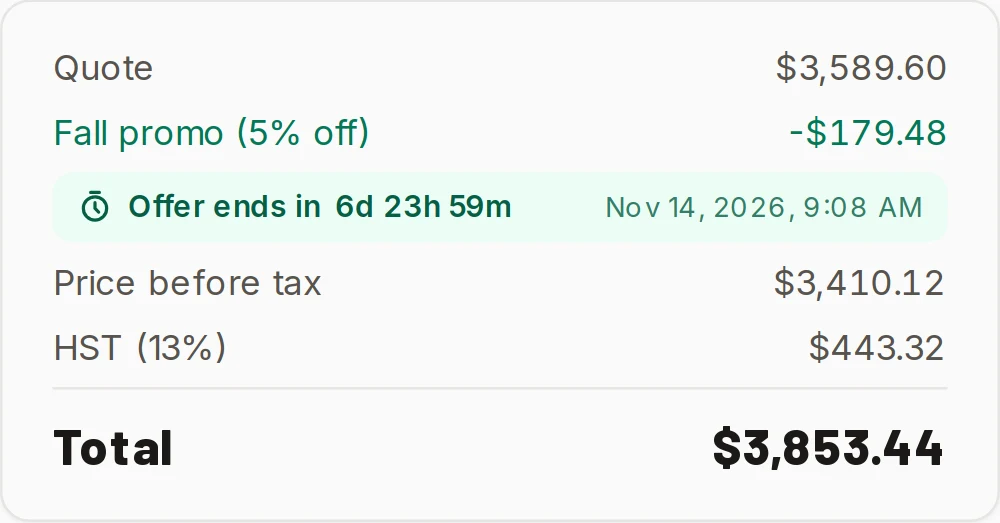
- 1Give it a reason the customer can see: "Fall promo", "Returning customer", "Booked before March 1". A reason makes it a real offer, not a sign the price was inflated.
- 2Take it off the price before tax, on its own line. The customer sees your full price and what they save.
- 3Give it an end date. An offer that's open forever gives them no reason to decide this week. Seven days is usually enough to talk it over at home without it being forgotten.
- 4Keep the deadline. If it ends and you quietly honour it anyway, the next deadline means nothing. Extending it once on purpose is fine.
What to offer instead of money off
Often the customer doesn't need a lower price, they need a reason to pick you. Before you cut the price, try:
- An upgrade at no charge that costs you little: a closet, a front door, an extra coat on the trim.
- Options. Show a lean base price with optional extras the customer can add or leave off, so they choose what fits their budget.
- A better start date, or a guarantee you'll finish by a certain day.
- A longer warranty on your work.
Discounts in SmoothFlo
In an estimate's Pricing card, the Discount box takes a dollar amount or a percent, a short reason the customer sees ("Fall promo"), and "Offer ends after" a number of days. The clock starts when you first send the estimate.
- The customer sees the discount on its own line with a live countdown under it, ticking down by the second on the last day.
- When time runs out, the discount drops off by itself and the customer sees the full price.
- For big jobs, large project pricing takes a percent off by size, set once in your settings, so every big quote is discounted the same way.
- Optional extras let the customer build their own price, which often avoids a discount altogether.
Questions contractors ask
How much discount should a contractor offer?
Usually 5% or less, and only with a reason. Work out what the discount does to your profit first: on a job with a 20% profit, 10% off halves what you make.
Should a discount have an expiry date?
Yes. A deadline gives the customer a reason to decide now. About a week works for most home projects. Keep the deadline once you've set it.
What do I say when a customer asks for a better price?
Ask what they're comparing with, explain what your price includes, and offer options or an extra before money off. If you do give a discount, give it a reason and an end date.
Built for the trades
Do all of this in one place
SmoothFlo handles leads, door knocking, room-by-room estimates, follow-ups, invoices and job profit for contractors. The screenshots in this guide come from it.