How much of a deposit should a contractor take?
How big of a deposit trades and home service companies usually take, when to take it, when to ask for more, and how to make paying it easy so jobs stay on schedule.
By the SmoothFlo team · Updated November 8, 2026 · 6 min read
A deposit does two jobs. It covers the money you spend before the work starts, like materials and booking the crew, and it turns a "yes" into a commitment. A customer who has paid a deposit doesn't cancel the week before because another company called.
The question is how much to ask for without scaring off good customers.
Typical deposit amounts
There's no single right number, but most trades fall into a few ranges:
| Kind of job | Usual deposit | Why |
|---|---|---|
| Labour-heavy work (painting, cleaning, landscape maintenance) | 10% to 30% | Materials are a small part of the price, and the deposit mostly holds the date. |
| Material-heavy work (flooring, roofing, cabinets, windows) | 30% to 50% | You buy expensive materials before you start, often special orders that can't be returned. |
| Large or long jobs | A deposit, then payments at stages | Split the price across stages so neither side carries too much risk. |
| Small jobs | Often none, or a flat amount | A deposit on a $400 job adds a step that isn't worth it. |
A good rule: the deposit should at least cover your materials and the cost of holding the date. Rules on deposits for home improvement work vary by province and state, and some places set a limit, so check what applies where you work.
When to take it
Ask for the deposit when the customer accepts, not on the first day of the job. A job isn't on your schedule until the deposit is in. That protects your calendar: you won't turn away another customer for a date that might fall through.
When to ask for more
- Special-order materials that can't be returned.
- A busy-season date booked far ahead, where a cancellation would be hard to fill.
- A large job for a new customer you have no history with.
- Custom work you couldn't sell to anyone else.
Put it in writing on the quote
The deposit should be on the estimate before the customer accepts, never a surprise afterwards. Show:
- The amount or percent, and the dollar figure.
- When it's due (on acceptance).
- How to pay: e-Transfer, card, cheque.
- When the rest is due, and whether there are payments at stages.
Make paying easy
The harder it is to pay, the longer it takes. Give the customer the payment details on the same page where they accept, and an e-Transfer address they can copy in one tap. Then record it the moment it arrives so the job moves onto the schedule.
Deposits in SmoothFlo
- Set a default deposit percent once in Settings, and change it on any single estimate.
- The customer sees the deposit before they accept. Once they sign, their page asks for the deposit and shows how to pay.
- Ask for the deposit in one tap on the job's invoice.
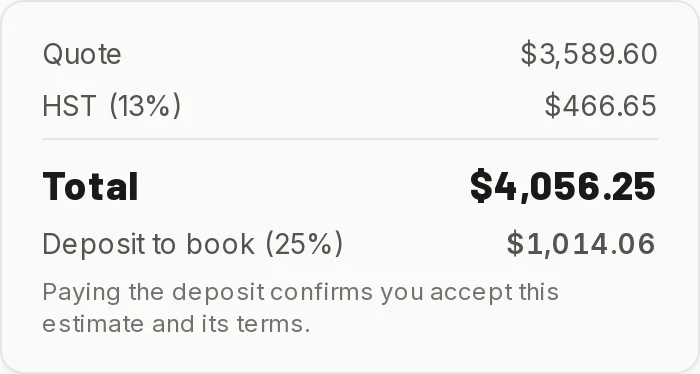
With the deposit in, the job is ready to book. For help getting the quote accepted in the first place, see how to write an estimate customers say yes to.
Questions contractors ask
What is a normal deposit for a contractor?
Often 10% to 30% for labour-heavy work like painting, and 30% to 50% when expensive materials are bought before the job starts. Check whether your province or state limits deposits for home improvement work.
When should a contractor collect the deposit?
When the customer accepts the quote. Put the job on the schedule once the deposit is paid.
Should small jobs have a deposit?
Often not. On a small job a deposit adds a step that isn't worth it. Some companies use a flat booking fee instead.
Built for the trades
Do all of this in one place
SmoothFlo handles leads, door knocking, room-by-room estimates, follow-ups, invoices and job profit for contractors. The screenshots in this guide come from it.